BranchInfo 2010 BranchInfo 2010 BA

Tuesday, July 19, 2011

GIS Enthusiasm at ESRI Business Summit

Photos & Video: Joseph Lackow
Last week's ESRI Business Summit was, for the very first time, visualized and presented as a business conference rather than a GIS conference.  This reminds me of how Economy.com conferences are about business not econometrics.  What is critical to my business here?

Clearly, the answer to that question, at the Business Summit, and the broader ESRI User Conference, is the power of place.

Jack Dangermond was particularly compelling and inspirational this year, opening the conference with an explosion of applications from all over the globe and all over the chart, one positive "game changer" after another after another.  


Jacqueline McGlade of the European Environmental Agency talked about the private citizen's role in climate change, and was very moving and inspirational as well.  Just One Degree = catastrophic climate change (and one great big melting polar bear ice sculpture), but just one person can act.  Jane Goodall's Roots and Shoots, same deal.

Timothy and Michele Schilling astounded everyone on Monday afternoon with their tale of improving the income of Rwandan families tenfold in a decade by using GIS to process and market Rwandan coffee (broadly available under the Community Coffee brand in the U.S.)  All of these presentations underscored doing good and doing well, the role of private for-profit companies in creating social as well as economic wealth.

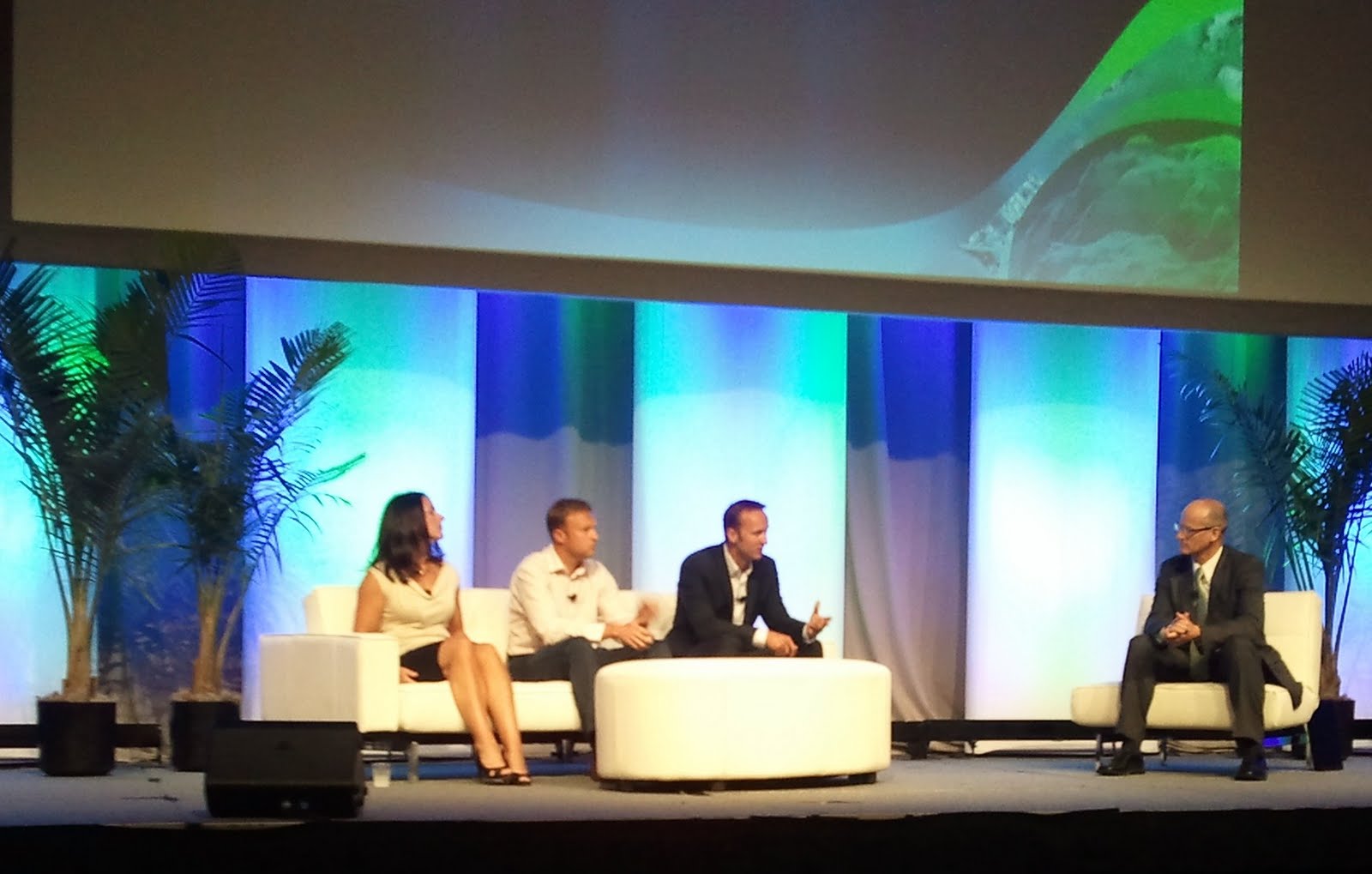
At the Business Summit, Warner De Gooijer of Cisco (video) gave a great, clear explanation of how Cisco uses GIS as the backbone of their supply chain through which customer parts can be delivered anywhere in the world, from the closest warehouse to the needy customer, in within as little as two hours.  In the same set of discussions, Nigel Davis of Willis Re (the insurance companies insurance company) talked about using crowd sourcing information from social networks like Twitter to help evaluate and manage risk and losses in a disaster.  And Michelle Ellington of the University of Kentucky showed the history of facilities management at the university from paper maps to digital GIS, all the while using the process as a tool to bring stakeholders together.  When I asked the panel for a model of how GIS developed in their organizations, they all agreed that find a senior manager champion, build strong GIS staff with interpersonal skills, and architect solutions as close to the heart of IT as possible were the keystones.


Earlier, Matt Mikula of Edward Jones provided a glimpse of the history of GIS usage at Edward Jones that was somewhat like Michelle's, but with the usual reticence towards fundamental systems changes at many financial institutions - where it's usually best to be second and allow someone else to be bleeding on the edge, and where IT is often tasked with wiring together different generations of technology that ends up looking like something out of the movie "Brazil".  Another Matt, Matt Felton of MacKenzie Commercial RE, was as enthusiastic as anyone in recounting how he makes GIS relevant to a large number of very different people and functions in his organization.  Genial Pat O'Hagan of Starbucks, who has become a fixture at this conference, was as helpful as always in explaining how Starbucks puts GIS - and business intelligence - to work.

RPM Map Gallery Entry, "Geography at Work"
RPM did its part by participating in the Map Gallery - which everybody should do, and also bring guests and family to the Reception on Monday night.  And, Elio stood fondly by as our longtime friend and RPM client Scott McClymonds of ARVEST Bank won a SAG Award for Special Achievement in GIS.  We began extending and enhancing the customer database using GIS with Scott in 1993.

In short, this was the best conference since the economic downturn and pone of the best ever.  With 15,000 attendees, it was also the largest..

Tuesday, July 5, 2011

ESRI 2011 User Conference Features Arvest Bank, Edward Jones

The ESRI 2011 User Conference in San Diego is nearly upon us, so get out those travelin' shoes.  Scott McClymonds of Arvest Bank will be receiving a Special Achievement in GIS Award, recognizing nearly two decades of GIS excellence at the Bank, on Wednesday.  Way to go, Scott!

The ESRI Business Summit will kick things off on Sunday morning July 10, where upwards of 200 business geography pros will gather to hear the latest and greatest from industry leaders - and each other.

Matt Mikula, IS Services at Edward Jones.

Added to the ESRI Business Summit speaker lineup is Matt Mikula, who is a key IS adminstrator for Edward Jones.  Matt is responsible for IS Financial Advisor and Branch Services, and supports many of the systems used by the firm's financial advisors and branch office administrators.  Edward Jones has been a pioneer shop for GIS, with a long track record (like Arvest) dating back two decades to Atlas GIS, the pioneering business geography platform which was purchased by ESRI in 1996.

Joining Matt will be a group of exceptional speakers from Cisco, Starbucks and others.  So, come on down, and hear about best practices, tips and tricks, new software features - and enjoy the usual raucous good time had by all.  Here's where to go for more information about the Summit, and about the User Conference, which runs all next week through July 15.

Friday, June 17, 2011

If You Can't Beat 'Em, Buy 'Em

CapOne bought ING yesterday, for $9 billion in cash and stock.  This moves CapOne up to #5 in deposits in the U.S. from #8.  The ING brand will persist for a year or more.

The deal makes a lot of sense from many perspectives, especially if CapOne adds assets (like the HSBC card portfolio, which includes many affinity cards).  There is access to a broad base of low cost funds.  There is a big gain in online know-how.  Most of all, as system conversions go, this one looks relatively painless as the two share quite a bit of technology.

Just one problem.  The kind of customer that ING has is typically a value-hungry, simplicity-minded, big bank rejector.  And among the big banks that ING customers reject, CapOne is high on the list.  In fact, in many ways, CapOne is the anti-ING - perceived by many to be a high fee, hard to do business with, even deceptive traditional bank.  One look at the ING customer response to the news, as suggested by online comments in response to news announcements, suggests that the difficulty here in conversion will be cultural rather than systemic.

This is going to create huge opportunities FOR YOU, super-regional, regional, and community banks and credit unions.  The latter have already made a lot of hay in the wake of the "death of free checking".

It's June 2011, do you know which of your customer households is doing business with ING, or fits the ING customer profile (online-savvy savers and fee-averse transactors)?  Yes indeed, another reason to lean heavily on a customer-relationship, lifestyle-oriented GIS system.

Wednesday, June 8, 2011

Merchants Rejoice as Senate Upholds New Debit Card Rules

Courtesy of National Public Radio, 2011
Banks will really need to find other ways of earning fee income now.  The Senate voted Wednesday to let the rule stand by which the Fed will slice away $12 billion in annual income represented by debit interchange, the fees that merchants pay banks each time a customer swipes a debit card.  Senators supporting the financial institutions' efforts to head off the Fed proposal fell six voters short of the 60 needed to prevail, 54-45.


Those charges now average 44 cents per transaction.  Let's get real.  That is well, well above the cost of a debit transaction carrying none of the risk of a credit based one.  BUT - the Fed ruling will hold those fees to a maximum of just 12 cents per swipe, and the law takes effect in about a month on July 21. While this might change, it probably won't now.

Smart banks will realize, and already have, that they need to enter retail financial businesses that earn fees. But most will simply look to place fees on what has been given away for years, and play right into the hands of online, non-traditional players, and non-banks. 

What a good time to dig into your GIS, and determine which of your trade areas have the kind of customers and overall community composition that spells success for financial, college, tax and retirement planning.  

When one needs fee income, one emphasizes products and services for which consumers have always paid fees, and gladly.  And studies continue to show that consumers still trust their banker more than, say, their stockbroker.  Simply ratcheting up NSF and late and other fees and creating new triggers for them simply won't get 'er done.  Making new kinds of relationships and stepping up to compete in the new environment, will.

Monday, June 6, 2011

U.N. Classifies Internet Access a Fundamental Human Right

On Friday, the U.N. Human Rights Council released a special report that underscores more than ever how important the Internet has become.  In doing so, they make a clear statement that limiting internet access in the 21st century is a serious restriction of human rights.

Specifically, that

(a) Everyone shall have the right to hold opinions without interference; and

(b) Everyone shall have the right to freedom of expression; this right shall include freedom to seek, receive and impart information and ideas of all kinds, regardless of frontiers, either orally, in writing or in print, in the form of art, or through any other media of his choice.

The report further outlines the seminal role and nature of the Internet.

"The right to freedom of opinion and expression is as much a fundamental right on its own accord as it is an “enabler” of other rights, including economic, social and cultural rights, such as the right to education and the right to take part in cultural life and to enjoy the benefits of scientific progress and its applications, as well as civil and political rights, such as the rights to freedom of association and assembly. Thus, by acting as a catalyst for individuals to exercise their right to freedom of opinion and expression, the Internet also facilitates the realization of a range of other human rights."

The problem?  We have a long long way to go to insure the kind of universal access to the internet that will foster human freedom and communications between people(s).  The report notes that "in contrast to 71.6 Internet users per 100 inhabitants in developed States, there are only 21.1 Internet users per 100 inhabitants in developing States (and) is starker in the African region, with only 9.6 users per 100 inhabitants." 

Further, the report notes that "without Internet access, which facilitates economic development and the enjoyment of a range of human rights, marginalized groups and developing States remain trapped in a disadvantaged situation, thereby perpetuating inequality both within and between States."

Clearly, many of us agree.  A BBC study last year found that for 79% of those interviewed in 26 countries,  Internet access is a fundamental human right.

This has  never more important than it is right now, in the "Arab Spring".  As the report also notes, "the recent wave of demonstrations in countries across the Middle East and North African region has shown the key role that the Internet can play in mobilizing the population to call for justice, equality, accountability and better respect for human rights."

Wednesday, June 1, 2011

Cellphone Safety: Another Perspective

The Announcement

On May 31, the International Agency for Research on Cancer  (an agency within the World Health Organization) announced results as a year-long analysis reviewing studies assessing the risks of cell phone use.  I'm a bit skeptical and critical of the World Health Organization press-briefing regarding cancer risks associated with cell phone use for a couple of reasons.

First of all (and possibly, most importantly) WHO has not released the manuscript yet, so there is really no way to assess the methodology of their meta-analysis. 

Secondly, the announcement was released as a press-briefing rather than a journal article, so it is not subject to the scrutiny of the peer-review process, as would any other study.  To-date,  the most valid in vivo studies done have failed to find conclusive evidence of a physiologic mechanism.  A meta analysis of such studies by Verschaeve, et al, (2010) concluded that "Many of the positive studies may well be due to thermal exposures, but a few studies suggest that biological effects can be seen at low levels of exposure. Overall, however, the evidence for low-level genotoxic effects is very weak."

Epidemiological Approaches

In the absence of conclusive in vivo studies it becomes a question of who can produce a valid epidemiological study.  One of the most often-cited studies, to-date attempted to correlate the incidence rates of gliomas and meningioma (brain cancers) with rates of cell phone use in Denmark, Finland, Norway, and Sweden from 1974–2003 (Deltour, 2009) based on over 58,000 cases of brain cancer.  The authors concluded that "The lack of a detectable trend change in incidence rates up to 2003 in this study suggests that the induction period for brain tumors associated with mobile phone use exceeds 5–10 years, that the increased risk of brain tumors associated with mobile phone use in this population is too small to be observed, that the risk is restricted to subgroups of brain tumors or mobile phone users, or there is no increased risk associated with mobile phone use. "

Responsible Health Communications

My concern is that by the very nature of their being made, comments by WHO regarding the need for more research intentionally or unintentionally communicates to the public that not enough research is being done.  In reality, much research  *is* currently underway, such as the 'Cosmos' study, which is a large-scale prospective cohort study of mobile telephone users (250,000 men and women aged 18+ years in five European countries - Denmark, Finland, Sweden, The Netherlands, UK), followed over 25 years (Schüz J, et al, 2010).

Media coverage

Although I am reserving judgment until WHO releases their monograph, organizations such as the World Health Organization have a particular obligation to follow evidence-based guidelines and to recognize the effects that their communications have on public perceptions and health behaviors . Although one might argue that the WHO working group is simply calling for more research, a strong argument can be made that such research is and has already been underway, making their call seem more like an unnecessary and alarmist call to action.  Given that media outlets are in the business as maximizing readership with compelling stories, it was no surprise to see the numerous dramatic headlines in today's (June 1) news, such as:
  • WHO: Cell phone use can increase possible cancer risk CNN. com
  • Cellphones, cancer: Study links cellphones to possible cancer risk
  • Cellphones may cause cancer, international agency says - NYPOST.com
  • Cellphones Possibly Cause Cancer, WHO Warns
Pronouncements such  as this one remind me as a quote I often share with public health students by Harvard epidemiologist, Dr. Walter Willet during an interview with Science Watch:

Interviewer: The science of risk-factor epidemiology is controversial these days because of what people call the "carcinogen" or "anxiety-of-the-week syndrome." It seems that every week the newspapers carry a new and usually contradictory study telling us what we should or should not eat. Is this our imagination, or is there really a problem? 

Willett: It's true; there is a problem. Part of it is this very direct link between ongoing work and what comes out in The New York Times. The natural course of science is that people do studies and report finding something, but nobody believes it too much-and, hopefully, neither do the investigators-until it's reproduced by other researchers. But in the meantime, it's on the front page of the newspaper. So there is this tendency for the least substantiated findings to be the ones coming out in the popular press, when in fact this is simply part of the scientific process, and a lot of suspected associations are not ready for the public to take action or even worry about.

Sources

L. Verschaeve a,*,1, J. Juutilainen b,1, I. Lagroye c,1, J. Miyakoshi d,1, R. Saunders e,1, R. de Seze f,1,T. Tenforde g,1, E. van Rongen h,1, B. Veyret c,1, Z. Xui,1. (2010).  In vitro and in vivo genotoxicity of radiofrequency fields. Mutation Research 705 (2010) 252–268

Schüz J, Elliott P, Auvinen A, Kromhout H, Poulsen AH, Johansen C, Olsen JH, Hillert L, Feychting M, Fremling K, Toledano M, Heinävaara S, Slottje P, Vermeulen R, Ahlbom A. (2010).  Cancer Epidemiol. 2011 Feb;35(1):37-43. An international prospective cohort study of mobile phone users and health (Cosmos): design considerations and enrolment. Cancer Epidemiol. 2011 Feb;35(1):37-43.

 Deltour, (2009). Isabelle Deltour, Christoffer Johansen, Anssi Auvinen, Maria Feychting, Lars Klaeboe and Joachim Schüz . Time Trends in Brain Tumor Incidence Rates in Denmark, Finland, Norway, and Sweden, 1974–2003. JNCI J Natl Cancer Inst (2009) 101 (24): 1721-1724. doi: 10.1093/jnci/djp415

Twitter Adoption Strongest Among African-Americans

Who uses Twitter?  Research released today by Pew Internet shows that usage skews towards the young and better-educated.  No news there.  What may be news to many people, however, is that usage skews towards non-White users.

Fully 25% of Blacks online have used Twitter.  This compares to 19% of Latinos online, and only 9% of Whites.

Heavy usage skews even more Black - while 11% of use Twitter daily, only 5% of Latinos and 3% of Whites do.

Pew also reports growth in usage among 30-49 year olds, where usage has doubled in less than 6 months, now 14%.  Usage still falls off considerably after age 49, to just 8% of 50-64s and 6% of 65+.
Household income is not much of a predictor, but at least some college education is, and so is urban and suburban residence.


That is quite, quite a different profile than that of the predominantly White, male, and dorky Twitter Twit.